Alignment Is Not Agreement: What Leadership Team Misalignment Really Looks Like

The meeting ends well. Everyone nods. The decision feels settled, the room breaks up, and people head back to their teams.
Three weeks later you find out the heads of three functions are each running a different version of what was agreed. Not because anyone defied the decision. Because each of them walked out with a different understanding of it, and none of them said so at the time.
This is what leadership team misalignment looks like. Not open conflict. Quiet divergence, dressed as agreement.
Alignment is not agreement
Most leaders treat alignment and agreement as the same thing. They are opposites more often than not.
Agreement means everyone holds the same opinion. Alignment means everyone backs the same decision, including the people who argued against it. One is a state of feeling. The other is a discipline.
This is what Patrick Lencioni calls the Team 1 principle. Your first loyalty as a leader is to your peers at the leadership table, not the team you run beneath it, which is what lets you argue hard in private and hold the line in public.
Worth saying plainly. Full agreement is not the goal, and chasing it is a mistake. A leadership team where everyone holds the same opinion is either practising groupthink or has quietly stopped arguing. Alignment is the goal, and it asks for the opposite. People say their piece, argue it hard, and once the call is made they back it and hold the line. The aim is not unanimity of opinion. It is genuine debate followed by real commitment.
The reverse is worth saying too. A leadership team in conflict is not necessarily misaligned. A room where people argue hard, push back on each other, and clearly do not always get along is often perfectly aligned, as long as the argument stays about the work and ends in a decision everyone backs. Friction is often a sign of health. It means people are saying what they think. The team you should worry about is not the one having the argument. It is the one avoiding it, then diverging quietly afterwards. One caveat holds. The conflict has to stay about the work. Once it goes personal, once people undermine each other for who they are rather than what they argue, it stops being healthy disagreement and starts eating the trust alignment runs on.
There is one thing a leadership team does need to share, and it is not opinions. It is the destination. People disagree about the route and still pull together if they know what winning looks like. Most misalignment is a group of capable people optimising for different end states nobody ever made explicit. Agree the destination first. Argue the route second.
And once the destination is set, hold it still. A leader who moves the goalposts every quarter trains the team to stop committing, because people learn the target will not survive long enough to be worth chasing. Revising the destination is sometimes right. Markets move and strategy adapts. The difference is whether the change arrives with a reason people understand, or turns up unexplained for the third time this year. The first is leadership. The second teaches people to wait and see rather than commit.
What misalignment looks like
Misalignment hides, because from the outside it looks like consensus. The room stays calm while the divergence shows up everywhere else. These are the things people feel long before anyone at the top names them. You might recognise some.
- The same project carries a different priority depending on which leader you ask. One team treats it as urgent. The other treats it as optional. The people below them are now fighting a war their leaders never had.
- A decision gets made in the room and then quietly does not happen, because two of the people who nodded had no intention of resourcing it.
- People take the same question to different leaders and get different answers, so they learn to shop for the one they wanted.
- Work stalls at the boundaries between functions. Nothing moves through the handoffs, because nobody agreed who owns the handoff.
- Initiatives launch half-resourced, fade, and reappear six months later under a new name, because the leadership team never truly committed to the first version.
- The strategy deck says one thing and the budget says another. Where the money and the headcount really go tells you the real priorities, and they do not match the stated ones.
- Middle managers turn into shock absorbers. They spend half their time working out what their leaders really meant and shielding their teams from the contradictions.
Every one of these traces back to the same root. Leaders holding different answers to the same questions, without resolving them between themselves. It surfaces in three forms.
Silent misalignment
The disagreement never surfaces. Everyone nods, the decision gets recorded, and then each person walks out and quietly does their own thing. It looks like harmony and behaves like sabotage. Usually it means the room never felt safe enough to say the hard thing out loud, so nobody did.
Leaky misalignment
The disagreement surfaces, but in the wrong place. Not in the meeting where it would do some good. In the corridor afterwards, in the skip-level, in a quiet word to their own team about what they really think of the plan. The decision gets undermined after the fact, by people who had every chance to challenge it and chose not to. This one is often a follower failure rather than a leadership one. Someone held their tongue when it counted, then relitigated the call once the room had emptied.
Engineered misalignment
The third form is the worst, and it is the one people rarely name, because it is deliberate.
I worked under a leader once who managed from this place. Not by accident. As a strategy. They kept their direct reports slightly divided, fed each of us a slightly different version of the priorities, and made sure no two of us ever had quite enough shared information to compare notes and push back together. United, we might have challenged a decision. Divided, the only path left was to escalate to them, one at a time, which kept them firmly in the middle of everything.
It worked, for a while. Then it curdled. People stopped trusting each other, because they had learned, correctly, information was being managed. They stopped trusting upward, because the inconsistencies became impossible to ignore. Good people left. It went toxic fast.
This is the distinction most writing on alignment misses. There is a difference between the leader who struggles to get alignment and the leader who does not want it. The first has a capability problem. They want their team aligned and have not built the conditions for it. This is fixable. The second has made a choice. The misalignment is the point. It keeps them in control. No process fixes the second leader, because they are not trying to solve the problem. They are the problem.
The capability problem usually looks more mundane than people expect. The person at the top communicates the priorities differently to each report, and does not realise it. Not out of any strategy. Out of haste, or inconsistency, or never having pinned down the priorities clearly enough themselves to repeat them the same way twice. Each leader walks away with a slightly different brief, certain they heard it right, and the divergence is built in from the first conversation. The boss believes they were clear. The evidence is three teams pointing in three directions. Saying something once is not the same as saying it so it lands the same way with everyone, and the gap between those two is where a lot of misalignment is born.
There is a difference between the leader who struggles to get alignment and the leader who does not want it.
What misalignment costs
The cost is not abstract.
Decisions freeze. When nobody is clear on the end game everyone is working towards, people stop making calls. They wait. They check. A decision a single person should have owned sits in limbo for weeks, because three people each assume someone else holds the authority, or each fears moving in a direction the others have not signed up to.
Self-doubt sets in. The same lack of clarity makes capable people second-guess themselves. If you are not sure what the team is really trying to achieve, you have no way to be sure your work is pointed the right way, so you hedge, you hold back, you redo things. Good people produce worse work when they struggle to read the room they are working inside.
Disengagement follows. People disengage from decisions they do not understand and from a direction they never see clearly. Over time they stop bringing their best thinking, because they have learned it might not survive contact with a strategy nobody explained.
And the goal itself rarely arrives clean. Two teams building toward versions of an objective never reconciled do not discover the gap early. They discover it at the join, when the pieces are supposed to fit together and do not. Then comes the rework. The reconciling which should have happened in a room months earlier now happens in code, in budgets, in half-built systems pulled apart and rebuilt to meet. The work lands late, over budget, and worse than it would have been, not because anyone lacked skill, but because two halves were aimed slightly apart from the start and nobody corrected the angle while it was cheap to do so.
The cost compounds downward. A leadership team quietly misaligned does not contain the problem at its own level. It exports it. Every team beneath inherits contradictory signals from their respective leaders and burns energy trying to reconcile instructions never reconciled at the top. The further down it travels, the more expensive it gets to fix.
Does seeking alignment slow you down
Leaders worry giving everyone a voice turns every decision into a committee. Sometimes it does. When it does, the slowness is usually a sign of a different fault, not a cost of inclusion.
Voice is not a vote. Everyone gets heard. Not everyone gets their way. A decision is not a tally of opinions in the room. Teams stall when they confuse the two, debating in circles because nobody named who decides. Name the decision owner and most of the slowness disappears. The debate has a deadline and an end point.
The thing people experience as slow is rarely the meeting itself. It is the relitigating. Teams who argue hard, reach a call, and commit move fast afterwards. Teams who never truly commit spend the following weeks reopening the decision in side conversations, which costs far more time than the original debate ever would.
This is the point where you might ask the obvious question. What if I am the one overruled. Why would I get behind a decision I argued against. The answer is trust, the kind earned over time rather than assumed. You back the call because you believe it was made in good faith.
There are moments when a leader should stop seeking input and simply decide. A crisis with no time to convene the room. A genuine deadlock, where the team has aired everything and still reaches no resolution. A non-negotiable already set above the team, where pretending it is open for debate wastes everyone's time. In each case the principle holds. The authority lives in the decision, not in the discussion. A good leader is generous with voice and decisive on the call.
Voice is not a vote.
Alignment is a shared discipline
This is the part where it would be easy to let leaders off the hook, so read it carefully.
Alignment is everyone's responsibility. The leader does not build it alone. The people in the room have a part, and so do the teams beneath them. Voice only works if people use it, in the room, on time, rather than saving their real opinion for the corridor afterwards. Commitment only works if people genuinely commit, rather than nodding and quietly carrying on as before. The leaky misalignment described earlier is often a follower failure, not a leadership one.
All of this is true. None of it lets the leader off the hook.
Shared responsibility is not equal responsibility. The leader owns the conditions. The team owns the uptake. Those are different sizes of job. A team uses voice only when the leader has made it safe to speak. A team commits only to a call the leader has clearly owned and communicated. A team follows rules of engagement only when the leader has made the rules explicit. If the conditions are not there, the failure belongs to the leader, fully. A leader complaining their team will not speak up is, more often than not, describing a room they built.
Which brings the rules into focus. Alignment is not a mood. A leadership team needs explicit rules of engagement. How decisions get made. Who owns each call. What disagree and commit asks of you once a decision is set. Where dissent belongs, and where it does not. Most teams never make any of this explicit, so each person runs a private version and the gaps between those versions get labelled misalignment. Writing the rules down is itself an act of alignment.
The rules should also name what does not come to the table. A decision genuinely contained within one leader's domain is theirs to make. What matters is not who the decision belongs to, it is who it affects. Affects others, they get a voice. Truly contained, the owner decides and informs the room. Consulting the whole table on a local call is its own kind of dysfunction. It is slow, it erodes ownership, and it trains leaders to seek cover instead of deciding.
How to build real alignment
Some misalignment is simple to fix. The communication failure described earlier, the leader briefing three people three different ways, corrects with clearer habits. Say it once, say it plainly, confirm it landed the same way with everyone. If this were the whole problem, alignment would be an administrative task.
It is not the whole problem. Most misalignment survives perfect communication. People hear the priorities clearly and still pull apart, because they do not trust the decision, did not feel safe enough to flag what they saw, or never committed past a nod in the room. Clearer messaging does nothing for any of it. Communication is the visible layer. The harder misalignment lives underneath it, in whether people trust the call and feel safe enough to challenge it before it is made.
You do not build alignment directly. Running an alignment workshop will not leave you aligned, the same way a trust workshop will not leave you trusting each other. Alignment is what shows up when other things are already in place. Chase it directly and you get the fake version, the polite nodding from the opening of this piece. Build the conditions and alignment falls out of them.
The conditions run in an order, and the order matters.
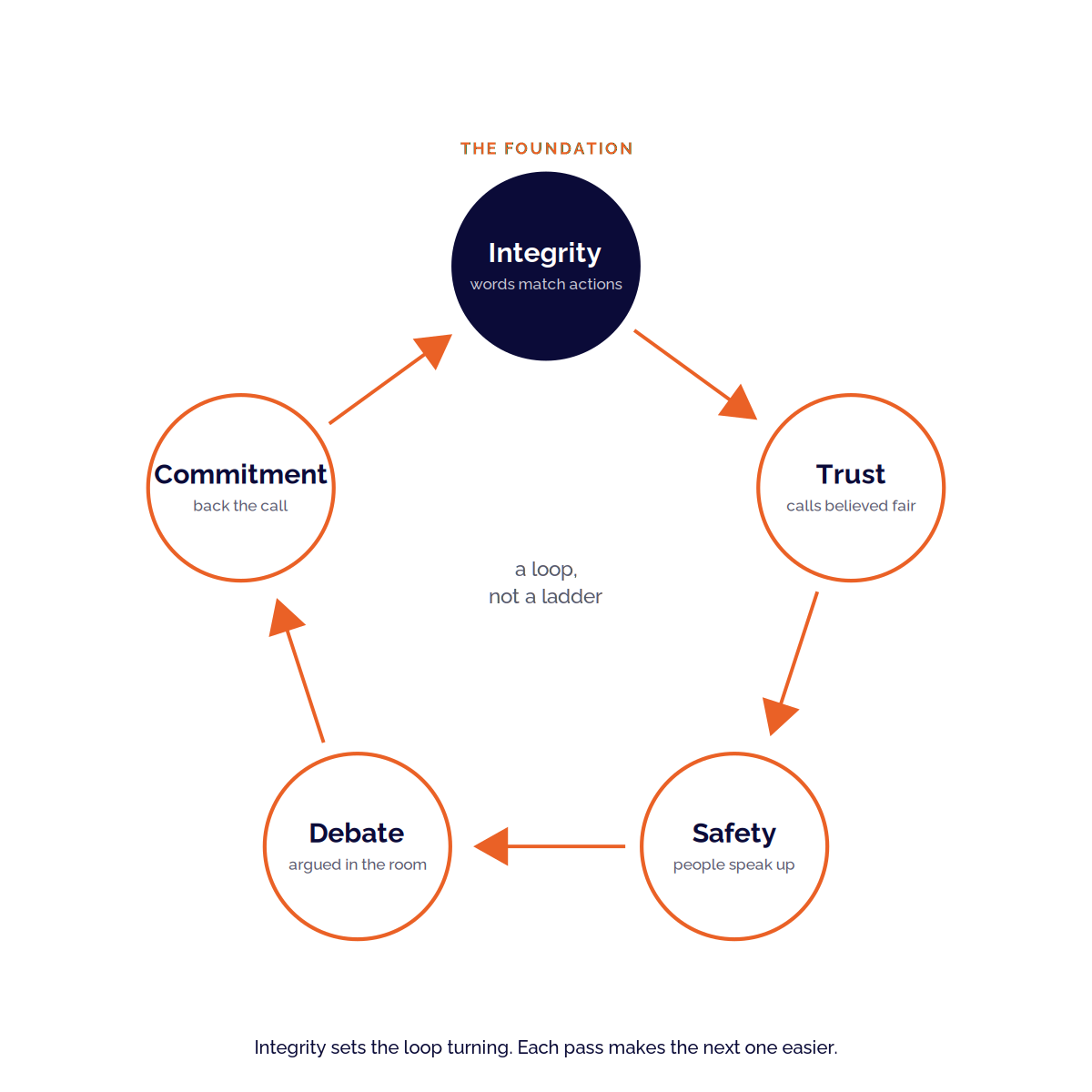
It starts with integrity. The leader's words and actions match, over time. Nothing else begins without this.
Integrity earns trust. People come to believe the calls are made in good faith, for the business, because they have watched the leader be consistent. Trust is what converts losing an argument into genuine commitment rather than resentful compliance. Pull trust out and disagree and commit collapses into people who comply in the room and undermine the decision the moment they leave it. Trust is also what lets people accept not being heard on a given call. No leader consults everyone on everything, and what makes the silence tolerable is the belief the leader weighed it fairly. This trust is not blind. It is earned through a track record of fair calls, and the leader keeps earning it or loses it.
Trust creates safety. People will say the unpopular thing, disagree openly, raise the risk nobody wants to name, because they believe it is safe to and they will be heard. Without trust there is no safety, and without safety people go silent, which is the first mode of misalignment all over again.
Safety produces real debate. The argument happens where it should, in the room, not the corridor.
Real debate plus a clear decision owner produces commitment. People back the call, even the ones who lost, because the process was fair and they trust the intent behind it. This behaviour has a name you might recognise. Disagree and commit. Andy Grove pushed it at Intel and Amazon later wrote it into its leadership principles. You argue your case fully. The decision gets made. Then you get behind it, even if you lost, and you hold the line when you leave the room.
Commitment, repeated over time, deepens trust. The leader becomes known as someone whose team holds the line, and the next call comes easier because the last one was honoured.
It is a loop, not a ladder. Each fair call makes the next one easier.
Run the loop in reverse and you have the toxic leader from earlier. No integrity, so no trust, so no safety, so no voice, so the leader is left manufacturing control through division, because they have destroyed the only thing producing alignment willingly. The same chain, running backwards, ending in the worst version of a leadership team.
This is also the honest answer to why alignment will not delegate. A leader hands off participation in it. The conditions stay with the leader, theirs to build or theirs to wreck.
Understanding how a leader is experienced by the people around them, rather than how they imagine they come across, is the work underneath all of this. It is the difference between a leader who believes they are trusted and one who knows whether they are. This gap is usually where the trouble starts.
Where this leaves you
If your leadership team looks aligned, hold it lightly. The room almost always feels more aligned than it is. The work is not to manufacture consensus. It is to build the conditions where real debate happens, real commitment follows, and the people who lost an argument still hold the line outside the room.
Methods are rented. The offsite, the workshop, the alignment session. The competencies underneath, the integrity, trust and safety from which real alignment grows, are owned. They get built slowly.
This is the work we do at Catalyst. If your leadership team is more divided than it looks, or holding together on politeness rather than trust, let's talk.
Frequently asked questions
How do I know if my leadership team is misaligned?
Misalignment rarely announces itself, because it looks like agreement in the room. Watch what happens after the meeting instead. If decisions get relitigated in side conversations, if different leaders give their teams different versions of the same plan, or if calls keep stalling because nobody is sure who owns them, you have leadership team misalignment. The meeting feeling smooth tells you very little.
Is full alignment realistic?
No, and you should not aim for it. A leadership team where everyone agrees on everything is either avoiding the hard conversations or has stopped thinking independently. The goal is genuine debate followed by real commitment, not unanimity. People should disagree on the route while sharing the destination.
Whose job is it to fix leadership team misalignment?
Everyone in the room owns their part, but the responsibility is not equal. The leader owns the conditions, whether it is safe to speak, whether decisions have clear owners, whether the rules of engagement are explicit. The team owns the uptake, using their voice in the room and committing to the call once it is made. A leader will not outsource the conditions to the people beneath them.
Will a leadership offsite fix misalignment?
Rarely on its own. An offsite is a method, and methods are rented. They produce a few aligned days and little of lasting value. Durable alignment grows out of trust, integrity and safety built over time, not a single session. Use the offsite to start the work, not to finish it.

Keep reading

When AI became my reflex