Entrepreneurial Leadership Is a Behaviour, Not a Personality

Entrepreneurial leadership means owning the outcome, acting within your constraints, and looking for what a problem makes possible instead of managing around it. It is a set of behaviours, not a personality type, and most organisations suppress the behaviours they say they want. This piece covers what it looks like, why it is rare, and how to build it.
Ask an executive team what they want from the next layer of leaders and "more entrepreneurial" comes up early. Ask what they mean and the answers split. Most land on a feeling. They want leaders who look at a problem and see what it makes possible, rather than one more reason the plan will slip.
The trait lists online describe founders. Founders own equity. Your leaders own a budget line and a team, and they answer to a structure built to reduce variance. A useful definition has to work inside those limits.
Most of what stops leaders behaving this way sits with the organisation, not the leader. A mindset program will not build it inside a system which punishes it.
What is entrepreneurial leadership?
Entrepreneurial leadership means owning the outcome, acting within your constraints, and looking for what a problem makes possible instead of managing around it. The line worth remembering is shorter. Lead as if the outcome is yours to own and the obstacle is yours to use.
Ownership comes first. The leader treats the result as theirs, not as something the organisation will deliver around them. Orientation comes second. When a problem lands, their first question is what it opens up, not how to make it go away.
A leader who sees the opportunity but does not own the outcome is a commentator. A leader who owns the outcome but sees every challenge as a threat is a grinder, and grinders wear out their teams. Entrepreneurial leadership is the combination, and it is a set of things a person does, not a type of person.
In practice it looks like this. A new compliance requirement lands on an operations manager. Most treat it as a cost and a deadline. She works out every competitor has to make the same change, so the first to do it well gets to talk about it with clients. She rewrites the process in a month, uses it in the next tender, and owns the result either way. Nothing in the sequence needed a founder's temperament.
What does an entrepreneurial leader do differently?
They diagnose before they reframe. They name what went wrong with precision, including the part they own, before asking what the miss makes possible. Seeing the situation accurately is one skill. Deciding what it makes possible is another. The order matters. Skip the diagnosis and the reframe reads as spin. Teams recognise spin immediately and stop listening. This is also what separates them from an optimist. An optimist skips the accurate reading because it is uncomfortable. Denial with better presentation.
They ask what the problem makes possible before asking how to make it go away. A question asked in the room, not a feeling. A lost deal becomes market intelligence. A budget cut becomes the reason to stop work nobody would defend. A resignation becomes a redesign of the role. The problem is still a problem. The opportunity is not always commercial. Sometimes it is a simpler process, or a failure removed for good. The question changes what the leader does with it.
They act with what they have. Most leaders in established organisations wait for the business case, the headcount, the platform. Entrepreneurial leaders run the small version first and bring results to the funding conversation instead of a proposal.
They hold themselves to the result, not the effort. They know what their team costs, what it produces, and how the business makes money. Plenty of leaders are excellent with people and have no idea how the organisation earns revenue. The components are in Business Acumen: The Strategic Skillset That Sets Professionals Apart.
None of this means taking more risk. It means sizing risk. The test is simple. Would the leader still take the action if their own name were attached to the loss? If yes, the risk is owned. If no, it is being passed to someone else.
Why do so few leaders lead this way?
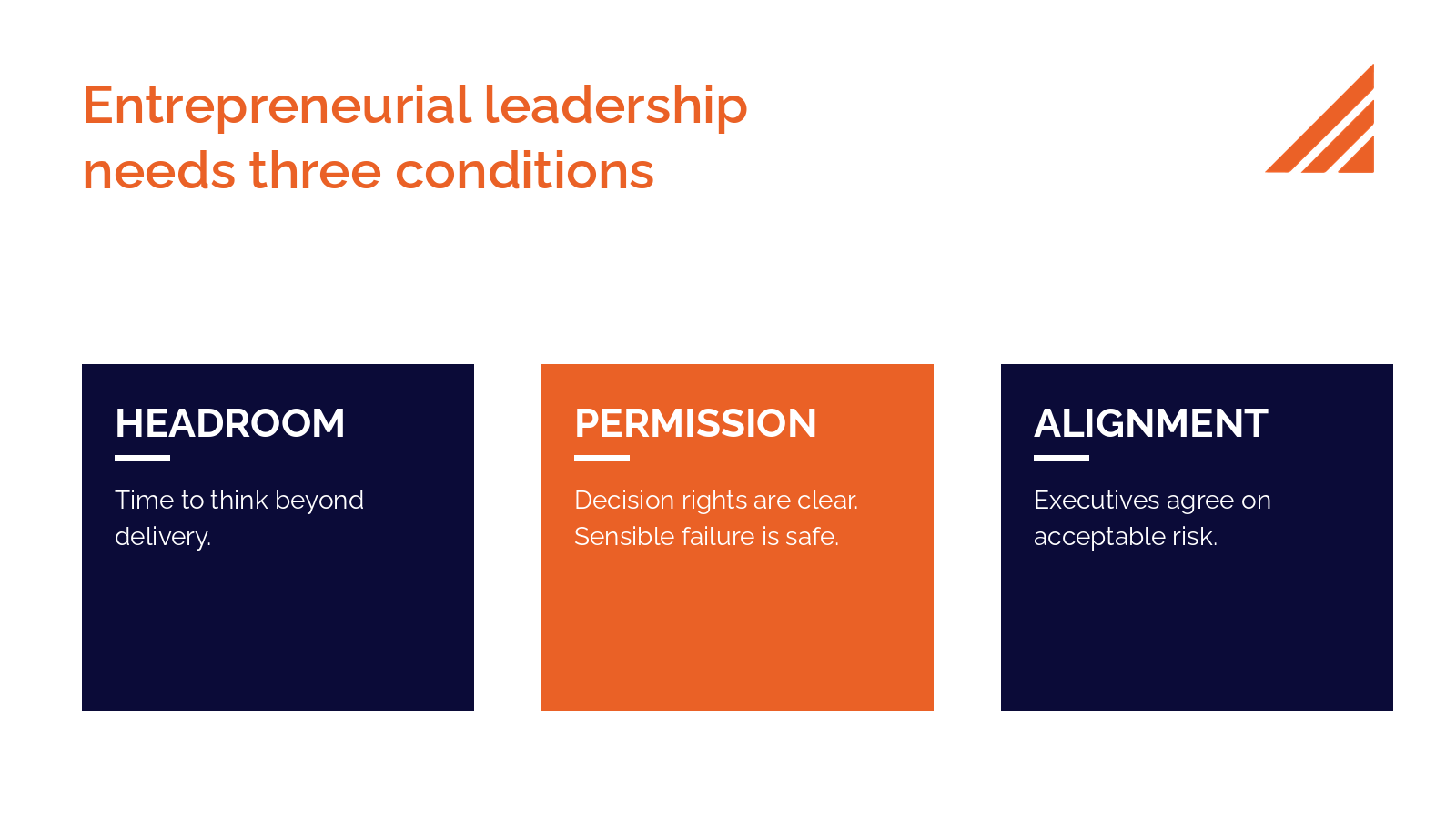
Because the organisation trains them not to. Executives explain the shortage as temperament. Temperament plays a small part. Two conditions explain far more.
Headroom is one. A leader with no operational slack experiences every challenge as another item on the list. Asking them to scan for opportunity is asking for something the week does not contain. In mid-market organisations this is sharper, because most leaders carry a delivery load of their own.
Permission is the other, and it breaks in two ways. The loud way is punishment. Leaders learn the real rules by watching their peers. A colleague takes a sanctioned risk. It fails. The response is a post-mortem with a name on it. Every leader who watched now sees threats, because seeing threats keeps them safe.
The quiet way is authority never granted at all. I have been on the receiving end of this. I worked on projects described as mine. Then came the sign-off points. Approval to start, approval on the approach, approval on the spend, approval before anything reached anyone senior. The project was mine in name and the decisions belonged to a chain. What it produced in me was not boldness. It was eye-rolling, and a slow boredom with work I was supposed to care about. I played the project manager role they clearly wanted. I was not going to put my name to an outcome I did not control. This is what withheld authority does. Ownership is never assigned. It is given, with the decisions attached, or it quietly declines into administration.
Then the organisation notices the shortage of entrepreneurial leaders and books a mindset workshop. Nothing changes, because participants return to the same week and the same rules. It is the pattern in Why Most Leadership Development Fails, applied to one capability.
The organisation manufactures the shortage, then books a workshop to fix it.
One condition sits above both. If the executive team is split on acceptable risk, the layer below picks the safest reading. Leadership team misalignment becomes caution everywhere below it.
How do you develop entrepreneurial leaders in an established organisation?
Fix permission and headroom first. Build the behaviours second. Reversing the order wastes the budget.
- Decide what risk you will tolerate and write it down. State the size of decision a leader makes without approval and the kind of failure the organisation will accept. Ambiguity reads as prohibition.
- Get the first failure right. Every leader is watching the response. Ask what was learned, not who approved it. One conversation tells every leader watching what the real policy is.
- Create headroom. Remove one reporting requirement per leader. Clarify decision rights so they stop escalating decisions they are allowed to make.
- Build the four behaviours on live problems. Reviews open with what we got wrong, and the leader goes first. Someone asks what the problem makes possible before anyone proposes a fix. Fund small experiments with a stated result and a stop date. Teach every leader their cost base and contribution.
- Reward the behaviour, not only the outcome. Recognise the well-designed experiment which failed and was stopped on time.
Fix permission and headroom first. Build the behaviours second. Reversing the order wastes the budget.
What this means for people leaders and L&D
L&D gets handed behaviour problems which are system problems. If leaders are punished for sensible risks, no training will make risk-taking stick.
Before you build or buy a program, audit the system it lands in. What happened the last time a leader took a risk and it failed? How much of a leader's week is delivery versus thinking? Does the executive team agree on acceptable risk? Which decisions are leaders allowed to make and escalate anyway? If the answers are poor, the program will fail and be blamed for it. If they are good, this capability builds faster than most, because the behaviours are observable, coachable and measurable.
If you are asking your leaders to be more entrepreneurial, ask a harder question first. Have you built an organisation where entrepreneurial behaviour is safe? If you want help answering it, book a conversation.
Frequently asked questions
Is entrepreneurial leadership the same as intrapreneurship?
They overlap and they are not interchangeable. Intrapreneurship describes entrepreneurial activity inside an existing organisation. Entrepreneurial leadership describes how a leader approaches ownership, decisions and constraints. An entrepreneurial leader often creates the conditions for intrapreneurship. Use the term your organisation recognises, and know the difference when someone asks.
Does entrepreneurial leadership mean taking more risk?
No. It means sizing risk, which sometimes means taking less. An entrepreneurial leader runs the small version of an idea before the large one, stops experiments early when the evidence turns, and would still take the action if their own name were on the loss. Leaders who bypass process and call it entrepreneurial are using up the organisation's tolerance, not showing judgement.
Is entrepreneurial leadership trainable?
Yes, if the organisation fixes permission and headroom first. The behaviours are observable and repeatable. Diagnosing before reframing, asking what a problem makes possible, acting with available resources, and holding yourself to results are all skills a leader builds through practice on real problems with feedback. Training them into a system which punishes the first failure produces a well-received workshop and no change.

Keep reading

When AI became my reflex